



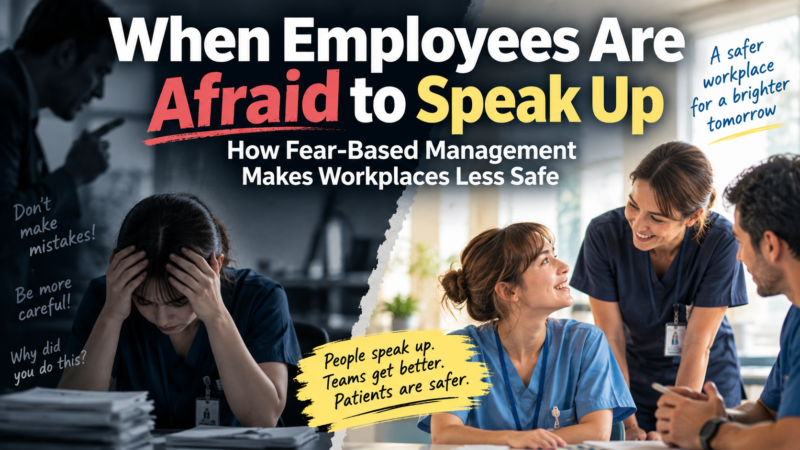
In healthcare and long-term care, the stakes are high.
We are responsible for people’s safety, health, dignity, and sometimes their lives. So there are moments when leaders need to be firm. Mistakes cannot simply be ignored, especially when they could put someone at risk.
But being firm is not the same as creating fear.
Yelling at employees.
Putting emotional pressure on them.
Humiliating them in front of others.
Using fear to make sure they “never make that mistake again.”
These approaches may appear effective in the short term. People become quieter. They follow instructions more carefully. The workplace may even seem more disciplined.
But silence is not the same as safety.
And fear is not the same as accountability.
Over time, fear-based management can make an organization less safe—not more.
- When the Goal Changes from “Work Safely” to “Don’t Get in Trouble”
- Psychological Safety Is Not About Being “Nice”
- Being Firm and Being Intimidating Are Not the Same Thing
- “Just Be More Careful” Is Not a Safety Strategy
- Facts Are Not Always the Whole Story
- Ask Two Questions: “Why?” and “What Were You Trying to Do?”
- Mistakes Are Rarely About One Person Alone
- Stop Depending on Perfect People. Build Better Systems.
- A Leader’s Job Is Not to Prove They Were Right
- People Do Not Grow Well Under Fear
When the Goal Changes from “Work Safely” to “Don’t Get in Trouble”
When employees repeatedly experience intimidation, humiliation, or harsh criticism, something important begins to change.
Their goal is no longer simply:
“How do I do this safely?”
It becomes:
“How do I avoid getting blamed?”
That difference matters.
Once avoiding punishment becomes the priority, employees may become less willing to report mistakes, ask questions, or admit uncertainty.
Instead of saying:
“I think I made a mistake.”
they may stay quiet.
Instead of asking:
“I’m not sure what to do here. Can you help me?”
they may make a guess.
Instead of reporting a small problem while it is still small, they may hope nobody notices.
Fear does not necessarily eliminate mistakes.
Sometimes, it simply teaches people to hide them better.
Over time, this can lead to:
- Delayed reporting of mistakes and changes in a patient’s or resident’s condition
- Fewer questions when employees are uncertain
- Increased dependence on instructions rather than independent thinking
- Fewer safety checks
- Secondary mistakes caused by anxiety and rushing
- Employees performing below their actual ability
- New employees learning that being criticized is simply “part of the job”
- Poor staff development and higher turnover
- A workplace culture where employees watch and blame one another instead of supporting one another
Healthcare workers already operate in cognitively demanding environments.
Patient care, toileting, medication management, transportation, documentation, communication with families, and unexpected problems can all occur at the same time.
Add chronic psychological pressure to that environment, and you create conditions in which attention, working memory, judgment, and decision-making can become more difficult.
So we need to recognize an uncomfortable contradiction:
A management style intended to prevent mistakes can actually create conditions in which mistakes become more likely.
Psychological Safety Is Not About Being “Nice”
Fear-based leadership does not affect only the person being criticized.
Other employees are watching.
They learn:
“Maybe I’ll be next.”
Eventually, people begin to calculate what is safe to say, what should remain unspoken, and whether asking for help is worth the risk.
That is where psychological safety becomes important.
Psychological safety does not mean everyone has to agree.
It does not mean poor performance should be ignored.
And it certainly does not mean there are no consequences for unsafe behavior.
It means employees can say:
“I don’t know.”
“I need help.”
“Something seems wrong.”
“I made a mistake.”
without fearing humiliation or disproportionate punishment.
In healthcare, that is not merely an employee-satisfaction issue.
It is a safety issue.
Imagine two workplaces.
In the first, an employee asks a question and hears:
“Seriously? You still don’t know that?”
In the second, the response is:
“Good catch. Let’s check it before we continue.”
Which workplace is more likely to have employees who speak up before a small uncertainty becomes a serious incident?
The answer should be obvious.
Being Firm and Being Intimidating Are Not the Same Thing
None of this means leaders should avoid difficult conversations.
There are times when we need to say clearly:
“This is unsafe.”
“This cannot happen again.”
“This procedure must be followed.”
That is part of leadership.
But there is a fundamental difference between clarity and intimidation.
Yelling at someone, attacking their character, repeatedly bringing up old mistakes, emotionally cornering them, or humiliating them in front of coworkers does not make the message more educational.
It makes the experience more threatening.
The purpose of education is not to make someone suffer enough to remember their mistake.
The purpose is to make the safe behavior repeatable.
After an incident, the questions should be:
What happened?
Why did it happen?
What can we change so it is less likely to happen again?
A leader’s job is not simply to make the employee feel the weight of the mistake.
It is to help create a safer next attempt.
Good teaching rarely requires anger.
It requires clarity, patience, persistence—and sometimes the courage to say something difficult without turning it into a personal attack.
“Just Be More Careful” Is Not a Safety Strategy
One of the most common responses to a workplace mistake is:
“Be more careful next time.”
It sounds reasonable.
But think about what it actually means.
Was the employee deliberately being careless?
Probably not.
In many cases, the person believed they were being careful.
And the mistake still happened.
So if the entire corrective action is:
“Be more careful,”
we have not actually changed the conditions that produced the mistake.
We have simply transferred responsibility back to the employee and hoped that next time will be different.
Hope is not a system.
And “be careful” is not a reproducible safety intervention.
A better question is:
What needs to be different next time so that this mistake becomes harder to make?
That question takes us away from blame and toward prevention.
Facts Are Not Always the Whole Story
A common mistake among new supervisors and mid-level leaders is reaching conclusions too quickly.
An incident occurs.
Employee A appears to have made the mistake.
Therefore:
“Employee A is the problem.”
Case closed.
Except the case may not be closed at all.
What we can immediately see is not necessarily the whole story.
Behind one person’s mistake there may have been:
- Poor information sharing
- Unclear instructions
- Fatigue
- An unusually heavy workload
- Several tasks occurring simultaneously
- An inconsistent procedure
- A workplace where asking questions feels unsafe
If we rush to judgment based only on what is immediately visible, we may punish the person while leaving the actual cause untouched.
Then the same incident happens again.
Perhaps next time with a different employee.
Before deciding who is responsible, gather information.
Ask the employee what happened.
Ask others who were involved.
Look at the environment, workload, instructions, communication, and procedures.
A person who is unfairly blamed may apologize outwardly while thinking:
“You never even tried to understand what happened.”
Once that happens repeatedly, trust begins to disappear.
And when trust disappears, communication usually follows.
Ask Two Questions: “Why?” and “What Were You Trying to Do?”
Behind most human behavior is some form of reasoning, even when the final decision turns out to be wrong.
So when an employee makes a mistake, I find it useful to explore two questions:
What caused you to act that way?
and
What were you trying to accomplish?
These questions are different.
For example, an employee may have skipped a safety check because the unit was extremely busy.
That may be the cause.
But perhaps their intention was to avoid keeping another patient waiting.
Now the situation looks different.
The decision may still have been unsafe.
But instead of simply seeing an irresponsible employee, we can understand the reasoning that produced the decision.
That allows the employee to reflect:
“I was rushing because I didn’t want the patient to wait. But looking back, I prioritized the wrong thing.”
Or:
“I felt I had no other option at the time, but now I can see there were other ways I could have handled it.”
That is a much deeper form of learning than:
“Don’t do that again.”
The leader does not always need to provide the answer immediately.
Sometimes the most powerful thing we can do is help employees understand their own decision-making.
When people identify the problem themselves, recognize alternatives, and choose a better response, they begin to develop something far more valuable than obedience:
professional autonomy.
Mistakes Are Rarely About One Person Alone
When an incident occurs, organizations often reach for the easiest explanation:
“Human error.”
Or:
“They weren’t paying enough attention.”
Sometimes individual responsibility absolutely matters.
But many incidents involve structural factors as well.
For example:
- Work was concentrated into a short period of time
- Critical information was not shared
- Double-checking existed on paper but not in practice
- The manual was unclear
- Different supervisors gave different instructions
- Employees were exhausted
- Someone was too intimidated to ask a question
If we genuinely want fewer incidents, we have to look beyond:
“Who made the mistake?”
and ask:
“What made this mistake possible?”
That does not remove personal accountability.
It makes accountability more intelligent.
Stop Depending on Perfect People. Build Better Systems.
Human beings make mistakes.
Experienced employees make mistakes.
New employees make mistakes.
Highly motivated employees make mistakes.
Even excellent professionals make mistakes.
So a safety system that works only when every employee remembers everything, notices everything, interprets everything correctly, and makes the right decision every time is not a very good safety system.
If your system requires perfect people, your system is already broken.
Consider pressure-injury prevention.
Imagine that repositioning or pressure relief is left entirely to each caregiver’s judgment.
One person may think:
“We’re too busy right now. I’ll do it later.”
Another may think:
“They look comfortable, so it probably isn’t necessary.”
Another may decide:
“They’re asleep. I don’t want to disturb them.”
Even well-intentioned employees will make different decisions.
Now change the system.
For example:
- Use reminders or timers so the task is harder to forget
- Establish specific times for pressure relief
- Assign responsibility to a defined staff role during each shift
- Standardize safe techniques and appropriate equipment
- Establish clear criteria for who requires the intervention and when
Now the process depends less on memory, mood, experience, or individual interpretation.
A new employee and a veteran employee can reproduce the same basic safety behavior.
That is the power of systems.
For high-risk tasks especially, we should be cautious about relying on individual judgment when a clear, repeatable process can reduce unnecessary variation.
Don’t build a workplace where safety depends on having the “right person” on duty.
Build one where the system helps ordinary people consistently do the right thing.
A Leader’s Job Is Not to Prove They Were Right
People grow best in environments where they can:
- Check
- Ask
- Reflect
- Improve
- Learn
That requires leaders to create conditions where employees can speak honestly about mistakes and uncertainty.
It means:
- Don’t emotionally condemn mistakes
- Establish the facts before judging
- Check the employee’s understanding
- Explore why the incident happened
- Develop prevention strategies together
- Make reporting easier, not harder
- Recognize small improvements
- Build relationships in which asking for help feels safe
Again, psychological safety is not permissiveness.
Unsafe behavior still needs to be addressed.
Standards still matter.
Accountability still matters.
But accountability without curiosity quickly becomes blame.
And blame without learning does very little to make the next incident less likely.
In healthcare and long-term care, the ultimate goal is not to protect a leader’s authority or prove who was right.
It is to protect the people we serve—and to help the people caring for them become safer, stronger professionals.
People Do Not Grow Well Under Fear
Fear can produce obedience.
For a while.
An employee may become extremely careful when a certain supervisor is nearby.
They may stop challenging instructions.
They may stop asking questions.
They may appear more disciplined.
But that does not necessarily mean they have become safer.
Sometimes it simply means they have learned how to survive the workplace.
What we should be building instead is a workplace where employees report problems because protecting patients matters, not because they are afraid of being caught.
A workplace where people double-check their work because safety matters, not because they fear humiliation.
And a workplace that responds to mistakes by asking not only:
“Who did this?”
but also:
“How do we make sure this doesn’t happen again?”
Leadership is not about making people afraid enough to obey.
It is about helping people become capable enough to think, speak up, and act safely even when the leader is not in the room.
Fear creates silence.
Safety creates communication.
And communication prevents harm.
That is the culture worth building.